
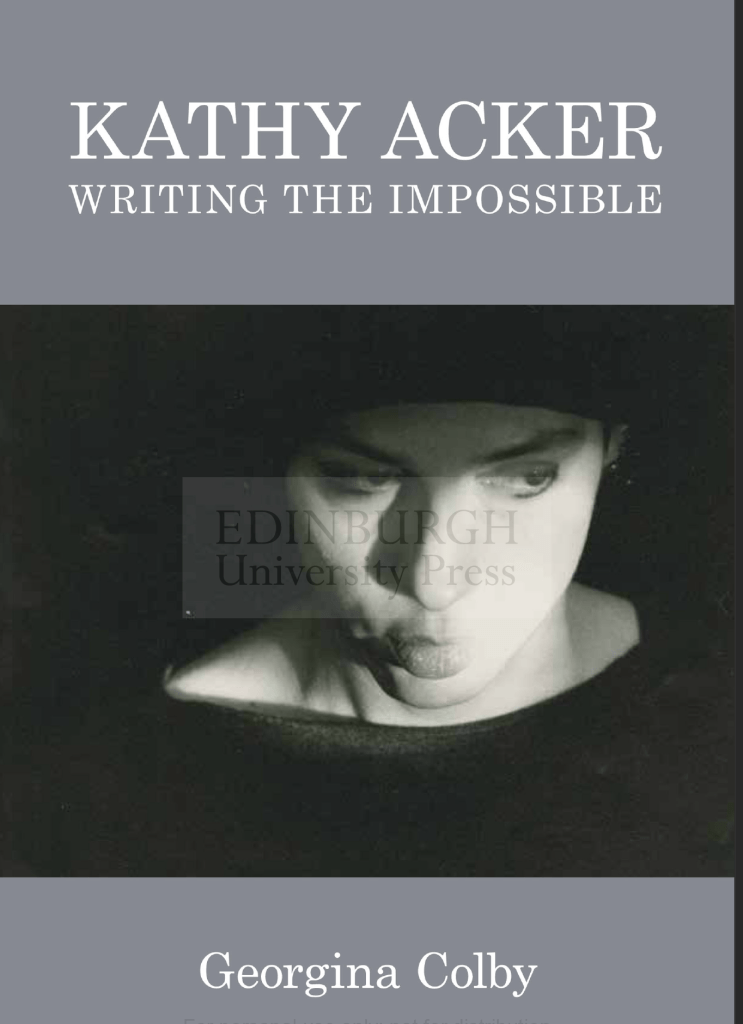
Kathy Acker: Writing the Impossible (Edinburgh University Press, 2016)
Kathy Acker’s body of work is one of the most significant collections of experimental writing in English. In Kathy Acker: Writing the Impossible, Georgina Colby explores Acker’s compositional processes and intricate experimental practices, from early poetic exercises written in the 1970s to her final writings in 1997. Through original archival research, Colby traces the stages in Acker’s writing and draws on her knowledge of unpublished manuscripts, notebooks, essays, illustrations, and correspondence to produce new ways of reading Acker’s works. Rather than treating Acker as a postmodern writer this book argues that Acker continued a radical modernist engagement with the crisis of language, and carried out a series of experiments in composition and writing that are comparable in scope and rigor to her modernist predecessors Stein and Joyce. Each chapter focuses on a particular compositional method and insists on the importance of avant-garde experiment to the process of making new non-conventional modes of meaning. Combining close attention to the form of Acker’s experimental writings with a consideration of the literary cultures from which she emerged, Colby positions Acker as a key figure in the American avant-garde, and a pioneer of contemporary experimental women’s writing.
Read Diarmuid Hester’s review of Kathy Acker: Writing the Impossible for Critical Quarterly here.
Reading Experimental Writing (Edinburgh University Press, 2019)
Bringing together internationally leading scholars whose work engages with the continued importance of literary experiment, this book takes up the question of ‘reading’ in the contemporary climate from culturally and linguistically diverse perspectives. New reading practices are both offered and traced in avant-garde writers across the twentieth and twenty-first centuries, including John Cage, Kathy Acker, Charles Bernstein, Erica Hunt, Theresa Hak Kyung Cha, Rosmarie Waldrop, Joan Retallack, M. NourbeSe Philip, Caroline Bergvall, Uljana Wolf, Samantha Gorman and Dave Jhave Johnston, among others. Exploring the socio-political significance of literary experiment, the book yields new critical approaches to reading avant-garde writing.
Read Shannon Finck’s review of Reading Experimental Writing for American Literary History here.
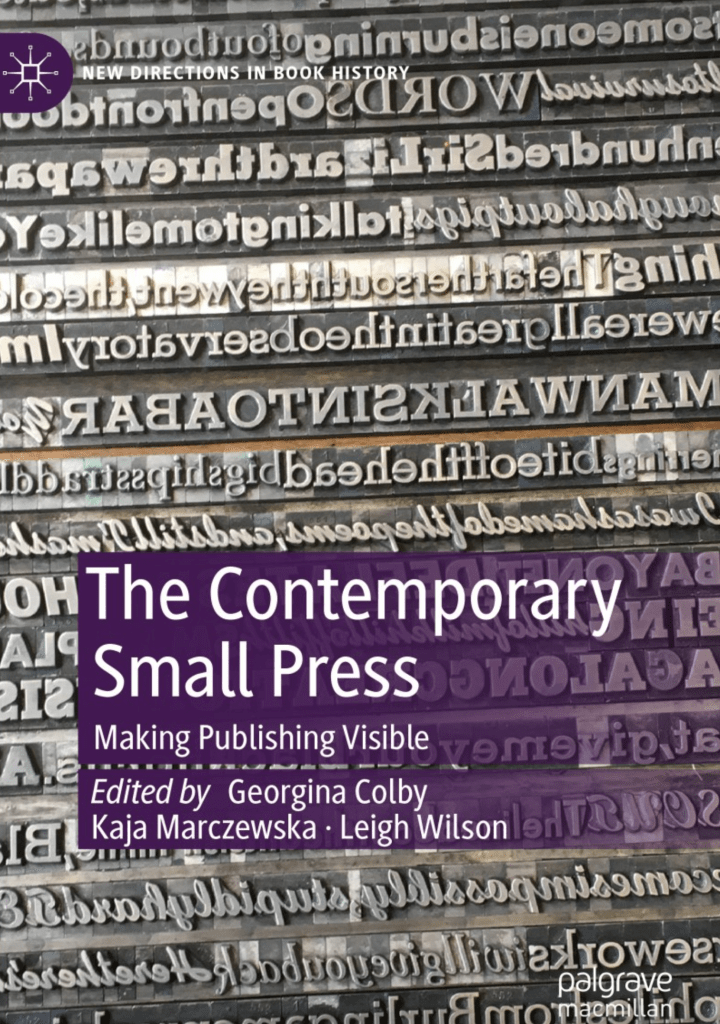
The Contemporary Small Press: Making Publishing Visible (Palgrave Macmillan, 2020)
The Contemporary Small Press: Making Publishing Visible addresses the contemporary literary small press in the US and UK from the perspective of a range of disciplines. Covering numerous aspects of small press publishing — poetry and fiction, children’s publishing, the importance of ethical commitments, the relation to the mainstream, the attitudes of those working for presses, the role of the state in supporting presses — scholars from literary criticism, the sociology of literature and publishing studies demonstrate how a variety of approaches and methods are needed to fully understand the contemporary small press and its significance for literary studies and for broader literary culture.

Death and the Contemporary, New Formations: A Journal of Culture, Theory and Politics, 89-90, 2017
This double issue of New Formations addresses death in contemporary culture from a number of interdisciplinary and international perspectives. Since Michel Foucault aligned the ‘power of sovereignty’ with the disqualification
of death in his 1975 essay ‘Society Must be Defended’, death has been at the forefront of biopolitical and geopolitical debates. Through a contemporary lens Achille Mbembe, writing in 2003, stated that the expression of sovereignty ultimately resides ‘in the capacity to dictate who may live and who may die’. Yet Mbembe’s necropolitics also questions the sufficiency of biopolitics to account for the question of death and sovereignty in the twenty-first century. This themed issue extends Mbembe’s challenge by taking up the complex, often contentious subject of death in present-day culture as it is thought, and as it operates, within and beyond biopolitics. In bringing together articles from scholars across the fields of politics, law, philosophy, and literature, the issue interrogates the conceptual status of death in biopolitical discourse by considering emerging post-biopolitical and post-human contexts.
 Georgina Colby